SEO
There are a lot of factors that make SEO a more viable long-term strategy for businesses. The most critical of them is the ability to create a sustainable asset for your business that compounds growth over time. You have complete ownership of high-ranking pages and other collateral, which can’t be said about other types of marketing.
With SEO, you can significantly lower the cost-per-lead acquisition for your business, ensuring your marketing spends are reduced comparatively. SEO ensures that your assets are permanently visible online, unlike other marketing methods like PPC, which are only visible as long as payment is made.
When it comes to building top-of-funnel awareness, SEO’s performance is hard to beat. Commonly searched phrases like “how to”, “near me”, and “where is” can generate huge traffic numbers that can be directed to your website through SEO.
A strong foundation of SEO means that your business is insulated against a majority of negative SEO attacks. It also makes it difficult for your competitors to replicate your success, as it takes time and effort to build up.
Advantages of Using SEO for a Website
1. Increased Organic Traffic
The key highlight with SEO has to be the amount of organic traffic it can generate over time. SEO can target users who are actively searching for keywords related to your products – called high-intent users. It makes them highly qualified leads that all businesses want.
Unlike paid ads that don’t produce any results once the budget is exhausted, SEO provides a consistent flow of qualified leads. The advantage of ranking for relevant keywords through SEO is that you can get a bulk of those clicks, which will lead to your website.
The advantage of organic traffic is that it won’t drop off immediately like paid traffic. You can also use retargeting in the form of ads to convert them into your customers or subscribers. SEO can also scale much more effectively without spending too much, unlike PPC.
2. Improved Brand Visibility and Awareness
The ability of SEO to get brand names into the minds of people with a much lower cost of entry, even today, remains unmatched. When people keep seeing your brand on related searches, even if they don’t click it at first, it does remain at the top of mind.
When your brand starts being placed on top of the results, it gets a “halo effect,” which ensures people have a positive opinion about your brand without even directly interacting with it. This kind of marketing may be subtle, but it does produce results over a period.
Add to this, multi-channel brand reinforcement through platforms like social media, and you have a brand that users are more likely to interact with. Again, SEO helps you with top-of-funnel awareness, where people are just starting out their customer journeys.
3. Better User Experience
One of the most vital factors of high-quality SEO funnels is its focus on UI/UX. Not many people are aware of the fact that user experience is also directly responsible for higher rankings on Google Search. A website that is easy to operate and navigate automatically improves its rankings.
The principles of SEO ensure that a website has a logical structure and users are able to find what they want without too much effort or being frustrated. Another aspect to note is that user experience today is a lot more dependent on mobile devices.
Responsive website design contributes greatly to improved user experience. It ensures your website is functional even when loaded on devices with varying screen sizes. Reduced bounce rates by giving users exactly what they’re looking for, which also impacts rankings.
4. Higher Trust and Credibility
When SEO is executed properly for your website, it rises in rankings naturally, even against the strongest competition. This gives your website a perception of being “endorsed by Google,” which garners trust and credibility in a crowded market. However, to make it to the top, you need to ensure that several things are in place.
One of the more important SEO aspects is security. The more secure websites are, the better the chances people will use them, and they will rank higher.
Websites can also gain credibility through leveraging backlinks from other high-authority websites. High-quality content can also improve your E-A-T (Expertise, Authority, Trustworthiness), ensuring more people trust in your brand.
5. Better Chance of Competing
SEO has the advantage of helping smaller brands compete with titans in the industry. With a brilliant SEO strategy, a more agile company can outrank a much bigger enterprise.
SEO helps you target relevant, long-tail keywords that have less competition but more specific phrases.

With more voice assistants using long-tail searches, it helps brands get to the top of rankings much more easily.
SEO has several competitor analysis tools that can uncover critical gaps in your competitors’ strategy, allowing you to exploit them. Rank higher for relevant keywords that they have not optimized. Smaller brands can also leverage the power of local SEO to get more foot traffic and better relevance for local searches.
Building a “wall” of quality content and backlinks can help you survive sabotage by bigger brands. It becomes difficult and even impossible to beat your brand on rankings in the short term.
6. Lower Cost per Lead
A standout feature of SEO compared to PPC is the amount you have to pay per acquired lead. SEO is more or less “free” (not including initial setup costs) when it comes to generating qualified leads.
The philosophy of SEO is that keyword ranks can compound over time, resulting in high saturation when it comes to organic searches.
It makes SEO much more powerful when it comes to long-term results, as it is much more efficient than outbound marketing. Considering that you don’t have to pay anything for users clicking on ads, it makes it much more cost-effective as well.
There is no need to waste ad spend like on PPC, where users have a minimal chance of converting. Or in other cases, clicks on PPC campaigns can be manipulated by competitors.
7. Long-Term Results and Asset Building
SEO is invaluable when it comes to building organic assets for your brand. The advantage of these organic assets is that they require very little maintenance but keep producing results over time. It ensures that the content you produce will have sustained visibility throughout its lifetime.
A key part of ensuring consistent leads from your assets is to upgrade them periodically to keep them aligned with current trends. It creates a framework of evergreen content that people will keep referring to others, netting you powerful word-of-mouth marketing as well.
Organic assets can also give you noticeable improvements to your domain authority, which can help you outrank competition. With proper SEO, you will outrank competitors using short-term paid ads or social media campaigns.
PPC
Pay-Per-Click marketing is an integral part of the digital marketing landscape, but it has limitations when compared to SEO. One of its biggest issues is the “instant shut off” effect that PPC has. When you stop paying for the PPC campaign, the ad, visibility, traffic, and leads all cease instantly. It does not leave behind a digital asset, unlike SEO.
Another major difference when it comes to costs between the two platforms is that PPC is a recurring expense compared to SEO, which has an upfront cost and negligible maintenance. Add to this the fact that PPC costs can also escalate owing to factors like competition and market scenario.
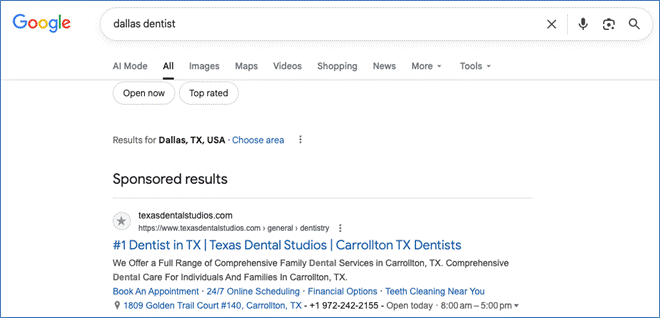
As a marketer opting for PPC, you’re in a constant bidding war against competitors, which can be tiresome and expensive. You should also be aware that PPC leaves you open to malicious attempts from competitors to drain your budget through click fraud.
Disadvantages of Using PPC
1. Escalating Costs for Ads
The biggest drawback with PPC ads is the escalating costs associated with the process. PPC involves bidding for the keywords you want against other equally motivated brands. This can often result in you having to stretch your budget for important keywords for your marketing campaign.
Even if you do win a bid, there are chances that you might have overpaid for it, which can further erode your profits. Also, inflation is something that can affect the cost of your paid ads year-on-year. This is especially true when you’re dealing with sectors like medicine, law, finance, and others.
The longer the customer lifetime of a business is, the more intense the bidding war is going to be. And for many companies, this puts them in the backseat against bigger opponents.
2. Traffic Stops When Spending Pauses
PPC works like a garden hose when it comes to traffic – once the budget is exhausted, the traffic stops. It makes PPC a strategy that has zero residual value with no lasting assets built during the process. It is akin to having a digital storefront that shuts down the minute payment stops.
PPC is not the most optimal choice for building long-term engagement. There is no compound growth that businesses can take advantage of, unlike SEO. It also leaves you vulnerable during budget cycles, as marketing can sometimes be the first expense to be cut.
It helps to think about PPC traffic as being “rented” as opposed to SEO traffic, which is “owned” by you. PPC can come in handy when you want quick results for ranking a specific keyword or traffic for an organic link.
3. Requires Considerable Time Investment
Contrary to popular belief that PPC is a set-and-forget type of marketing strategy, in reality, it requires constant monitoring and managing bids to be successful. Add to this the fact that the ad space is a constantly evolving platform, with new features and rules being added.
PPC campaigns are more granular than typical organic campaigns. For the best chance of success, marketers need to drill down to various elements of the campaign, like device, location, demographic, and schedule.
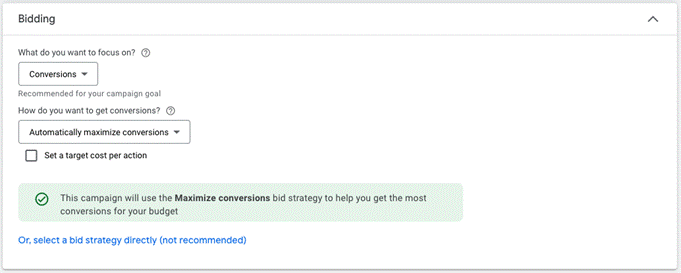
Marketers also need to continuously A/B test different parts of their PPC funnel, which can become overwhelming if they’re running several concurrent campaigns. PPC campaigns also need constant negative keyword analysis and removal to prevent overspending.
4. Chances of Click Fraud
A huge prevailing issue when it comes to PPC is the ability of competitors to deplete your marketing budget by simply clicking your ad. Rivals can create programs that repeatedly click your ads, which can result in your marketing budget being wasted.
While fraud detection systems do exist and refunds do happen, these are never perfect. Most often, you will be left talking to customer support when you should be focusing on your brand. Click fraud can also be difficult to prove if your competitor is using more sophisticated methods.
Click fraud can also result in skewed performance analytics, giving you results that are not accurate. To protect yourself, you need to invest in third-party tools, which eat into your marketing budget, further making it unprofitable.
5. Customer Ad Blindness and Fatigue
When talking about the psychological aspect of PPC ads, “banner blindness” is something that is not taken into account. Banner blindness is when users who have been conditioned over the years through PPC ads ignore them on searches.
In fact, this phenomenon is not even that rare. It is estimated that up to 86% of users tend to ignore PPC ad banners. When companies force ads on users, it results in ad fatigue that creates negative brand sentiment, which can further impact reputation and sales.
This is one reason why, when an option to skip ads is presented on any platform, people usually click on it. As a marketer, it is important to keep in mind the ad saturation of the average internet user. In fact, the more intrusive the ads are, the more people start resenting the brand.
Key Takeaways
- Prioritizing SEO to produce organic assets for your brand is a sound, long-term strategy that is also cost-effective.
- Invest in SEO when you want to compound your marketing returns over time through powerful content creation and backlink building.
- Recognize the power of organic marketing over paid marketing, but understand how you can use PPC effectively.
- Use PPC when you want a quick boost to your website traffic for organic assets.
- Ensure you have safeguards in place when using PPC that can prevent click fraud and other malicious attempts.
Build your perfect marketing strategy by combining both strategies intelligently – SEO can improve your PPC results.

I am a Tech geek and blogger, a seasoned freelancer, and my hobby is to enlighten my views and skills that will helpful for new inductions of the industry.
hello world
hello world